TikTok stopped loading for people on Omantel, Oman's largest internet provider, on the evening of Thursday 13 August 2026. There was no announcement. Within five hours, VPN demand from Oman had climbed to more than three times its normal level, and a full day later it has not come back down.
What makes this block unusual is how it behaves. TikTok's address points to servers run inside Oman, and those servers accept the connection and then leave it hanging. The app never shows an error. It just gets slow and loads in pieces. So the first wave of posts across Omani social media asked one question above all others: is something wrong with my wifi?
On Thursday evening, 13 August 2026, TikTok stopped working for people in Oman. The app would open and then stall. Videos played and then stopped. Comment sections never appeared. The first threads on r/Oman went up at about 8:20 pm local time, and over the following sixteen hours at least ten separate posts asked the same question in different words: has TikTok been banned again? No Omani authority announced a block, and no local outlet reported one.
The Open Observatory of Network Interference recorded the restriction at 9:35 pm Oman time. Its Web Connectivity test on Omantel (AS28885) flagged an anomaly for tiktok.com, and the underlying data shows what kind of block this is. The domain pointed to nine addresses that all sat in a single small range belonging to Zain Omantel International, rather than to TikTok's own servers. Connections to all nine opened normally on port 443, and then nothing came back. No error, no block page, no response of any kind until the connection timed out.
Omanis treated the whole thing as a repeat performance rather than news. One thread was titled "Tiktok banned once again?" and commenters described this as the second block, noting that the previous one was eventually lifted and that last time the ban was announced roughly a week in advance. Several also reported that Roblox is unavailable and that Reddit itself has become intermittent. The complaints were not limited to viewers: one poster asked what happens to "the people who have businesses, tiktok creators." As of publication, the internet-monitoring group NetBlocks has no report on Oman for this period, which is consistent with a restriction that was never announced.
Platforms affected:
For the six days before the block, VPN demand from Oman was flat. Every daily average between August 8 and August 12 sat within three percent of the others, moving only with the normal daily rhythm of evenings up and mornings down. That stability is what makes the next part legible.
From 9:00 pm on August 13, demand climbed for five hours without pausing, and peaked at +230% above the August 12 baseline at 2:00 am on August 14. It then settled into a band between +140% and +226% and stayed there through Friday morning. At the last reading, eleven o'clock on Friday, it was still running at +171% and rising again.
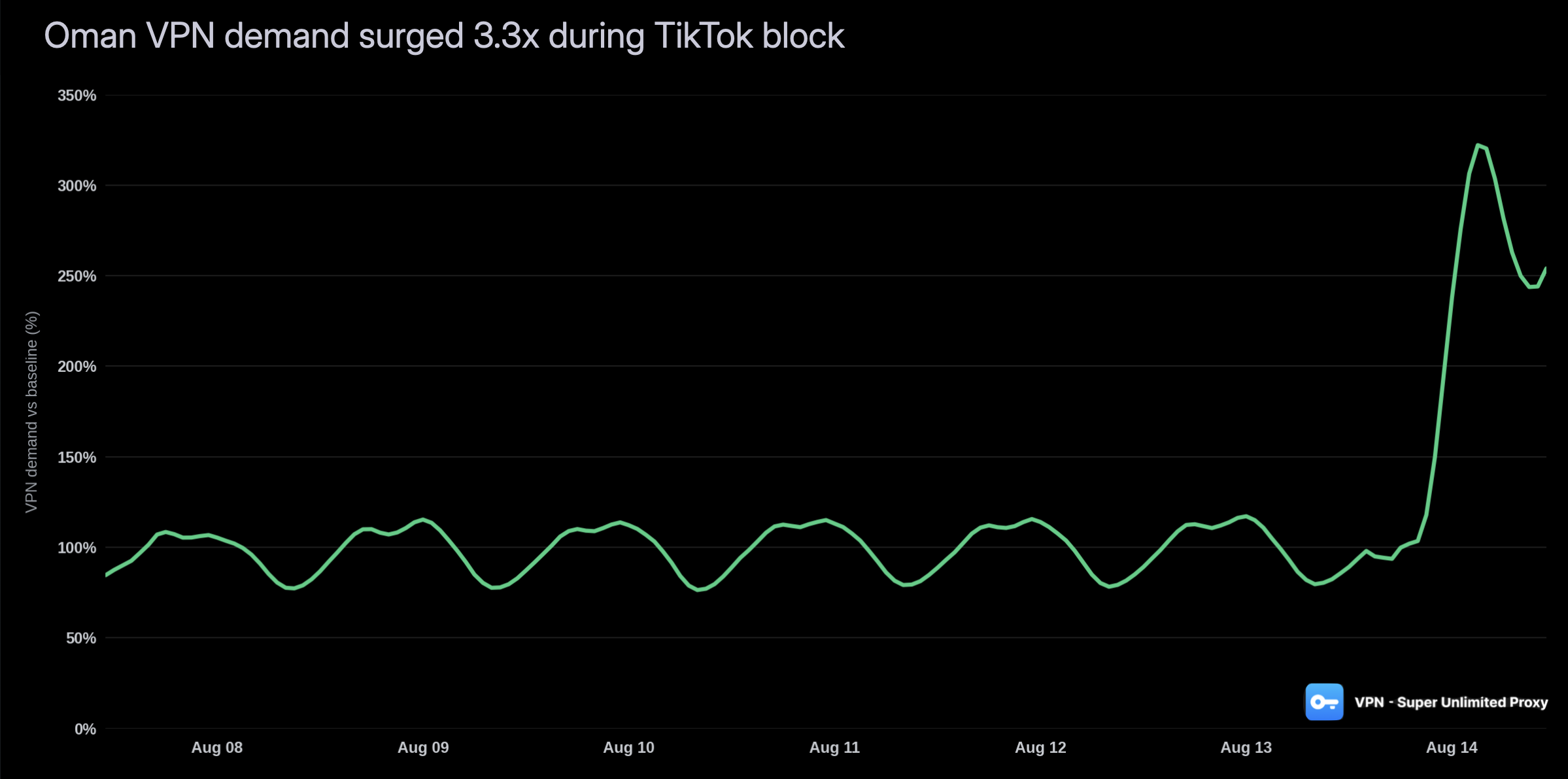
Hourly readings are smoothed with a three-hour rolling average in the chart above, which is why the plotted high point reads slightly lower than the +230% peak recorded in a single hour.
Day-by-day breakdown:
Three observations from the August 13 to 14 window, each grounded in the hourly series rather than the daily aggregate:
TikTok is one of the most heavily used apps in Oman, and the block removed it with no warning on a Thursday evening, at the start of the Omani weekend and in the middle of the busiest hours for social video. A VPN routes the connection through a server in another country, so a restriction applied inside Oman no longer sits in the path.
This is the easiest kind of block for a VPN to get around. TikTok itself is not turning Omani users away; a provider inside the country is stopping the connection before it leaves. Once traffic exits through another country, the restriction has nothing to act on, and the steps for reaching TikTok with a VPN are the same in Oman as in any other country where the app is restricted. Recognition is the harder half of this. Because the block presents as slowness rather than as a blocked page, plenty of people are still restarting their routers and blaming their internet plan, and a browsing problem takes longer to diagnose than an error message.
The pattern is familiar. The Iraq Telegram ban in April 2026 produced the same overnight jump when a single widely used app disappeared without notice; the Egypt Roblox block in February 2026 showed the same thing for a platform with a young user base. Single-app restrictions move VPN demand faster than broad shutdowns, because the workaround is obvious and the affected group is large and already talking to each other online.
Precedent: countries with similar restrictions
Oman's media law and its executive regulations give the Ministry of Information the authority to suspend licensed electronic media and to restrict content on broad grounds. TikTok, meanwhile, has never filed for an operating license in the country, and in April 2025 the telecom regulator publicly said it does not directly block the platform.
TikTok begins failing on Omantel. Videos stall part way, comment sections stop loading, and the first r/Oman threads appear at around 8:20 pm asking whether the app has been banned again. VPN demand is still at baseline.
OONI records the restriction on AS28885, with TikTok's domain pointing at provider-run addresses that accept connections and return nothing. VPN demand climbs for five consecutive hours to +230% above baseline, then holds.
The duration is the open question. Omani users describe this as the second TikTok block and say the earlier one was eventually lifted, which points to a restriction measured in days or weeks rather than a permanent removal. Nothing in the public record indicates how long it is meant to last, because nothing in the public record acknowledges it at all.
Scope is the second unknown. The OONI measurement covers Omantel, and one reading from one network cannot establish whether Ooredoo and Vodafone Oman are doing the same thing. User reports are mixed, with at least one person on Omantel saying TikTok still worked for them, which fits a restriction that arrived unevenly rather than all at once.
The VPN Observatory will keep tracking Oman's hourly demand through the coming week. The question is whether the curve decays as people give up on TikTok, or holds because they have found the rest of what a VPN does. Blocks that get lifted quickly tend to release demand just as fast; blocks that persist leave the baseline higher than it was before.
Stay connected even when the internet is under threat. Download a VPN to access uncensored news, reach family abroad, and protect your communications. For other ongoing case studies, see the VPN Observatory hub, which collates measurable digital-rights events month by month.
Yes, on Omantel. An OONI Web Connectivity measurement from 13 August 2026 recorded TikTok as unreachable on Omantel's network, with the domain pointing at provider-controlled addresses that accept connections and then return nothing. No Omani authority has announced the restriction, and no local outlet has reported it. Whether other Omani providers are affected has not been confirmed.
Because of how the restriction is built. TikTok's address points to servers inside Oman that accept the connection and then never reply, so the app waits instead of failing. Cached content keeps working for a while, which is why people report a few videos playing before everything stalls. The result looks like a bad connection, not a block.
Oman has not imposed a blanket ban on personal VPN use. The telecom regulator has framed its position around use that stays within national regulations and does not route around licensing requirements, rather than prohibiting the technology itself. Rules in this area change, and enforcement is a matter for Omani authorities, so check the current local position before relying on any general summary.
Yes. The restriction is applied by a provider inside Oman rather than by TikTok, so routing the connection through a server in another country takes it out of the affected path. Omani users reported exactly this within hours of the block, and the telemetry agrees: demand tripled overnight and stayed there, which only happens when the workaround works.
Unknown, and no authority has acknowledged it. Omani users describe an earlier TikTok block that was eventually lifted, and say that one came with about a week of advance notice. This one arrived with none. On that history, days or weeks is a more reasonable expectation than a permanent removal, but there is no official timeline to point to.
The confirmed measurement covers Omantel, AS28885, on a wifi connection. Ooredoo and Vodafone Oman have not been tested in the same window, so their status is unverified. Reports from Omani users are inconsistent even within Omantel, with at least one person saying TikTok still loaded for them, which suggests the restriction reached different parts of the network at different times.
The observation window runs from 7 to 14 August 2026, measured hourly in Oman local time (UTC+4). The baseline is 12 August 2026, the last full day before the restriction, chosen because the five days preceding it sat within three percent of each other. Hourly readings in the chart are smoothed with a three-hour rolling average; percentages quoted in the text are unsmoothed.
All figures in this article are expressed as percent change against that baseline. VPN Super does not publish absolute connection counts, server-level volumes, or per-country totals for any market. Third-party figures, where cited, belong to the organizations named below.
Internal data:
News and monitoring sources:
Note: VPN - Super Unlimited Proxy does not record your VPN browsing activities in any way that can be associated with you. The telemetry referenced in this article consists of anonymized, aggregated connection counts to destination-country servers, with no browsing activity, no DNS queries, and no per-user attribution. Aggregate hourly totals are used to identify country-level demand patterns tied to documented digital-rights events. No personal data is shared with third parties.


 VPN for Windows
 VPN for Android
 VPN for iOS
 VPN for MacOS
 Apple TV
 Android TV