On the night of July 27, 2026, President Mamadi Doumbouya's office read out a decree announcing a partial cabinet reshuffle. Prime Minister Bah Oury kept his job, several ministers were dropped, and three new officials, Djénabou Touré, Lansana Béa Diallo, and Bintou Keita, joined the government. Unconfirmed chatter about Doumbouya's own health spread online the same night, overshadowing the reshuffle itself.
By dawn on July 28, Guineans found Facebook, YouTube, and TikTok unreachable. The Guinean Bloggers' Association (ABLOGUI) activated its monitoring network and ran independent technical tests from Conakry and several regions. The results pointed to a deliberate, targeted block: the three platforms failed while every other service worked normally, which rules out a routine network fault.
ABLOGUI publicly demanded an explanation and immediate restoration, citing Guinea's constitution and its obligations under the African Charter on Human and Peoples' Rights and the International Covenant on Civil and Political Rights. Four days later, the telecom regulator (ARPT), mobile operators, and internet providers still hadn't said a word.
Platforms affected:
VPN traffic held to its usual daily rise and fall for four straight days before the blackout, averaging steady volumes with no unusual movement. It broke from that pattern within hours of the block.
Daily volume jumped 547% on July 28, then kept accelerating: up 2,143% on July 29 and 3,108% on July 30, the single busiest day in the eight-day window. The busiest hour on record landed even later, at 6 a.m. UTC on July 31, running roughly 27 times above the pre-blackout hourly average.
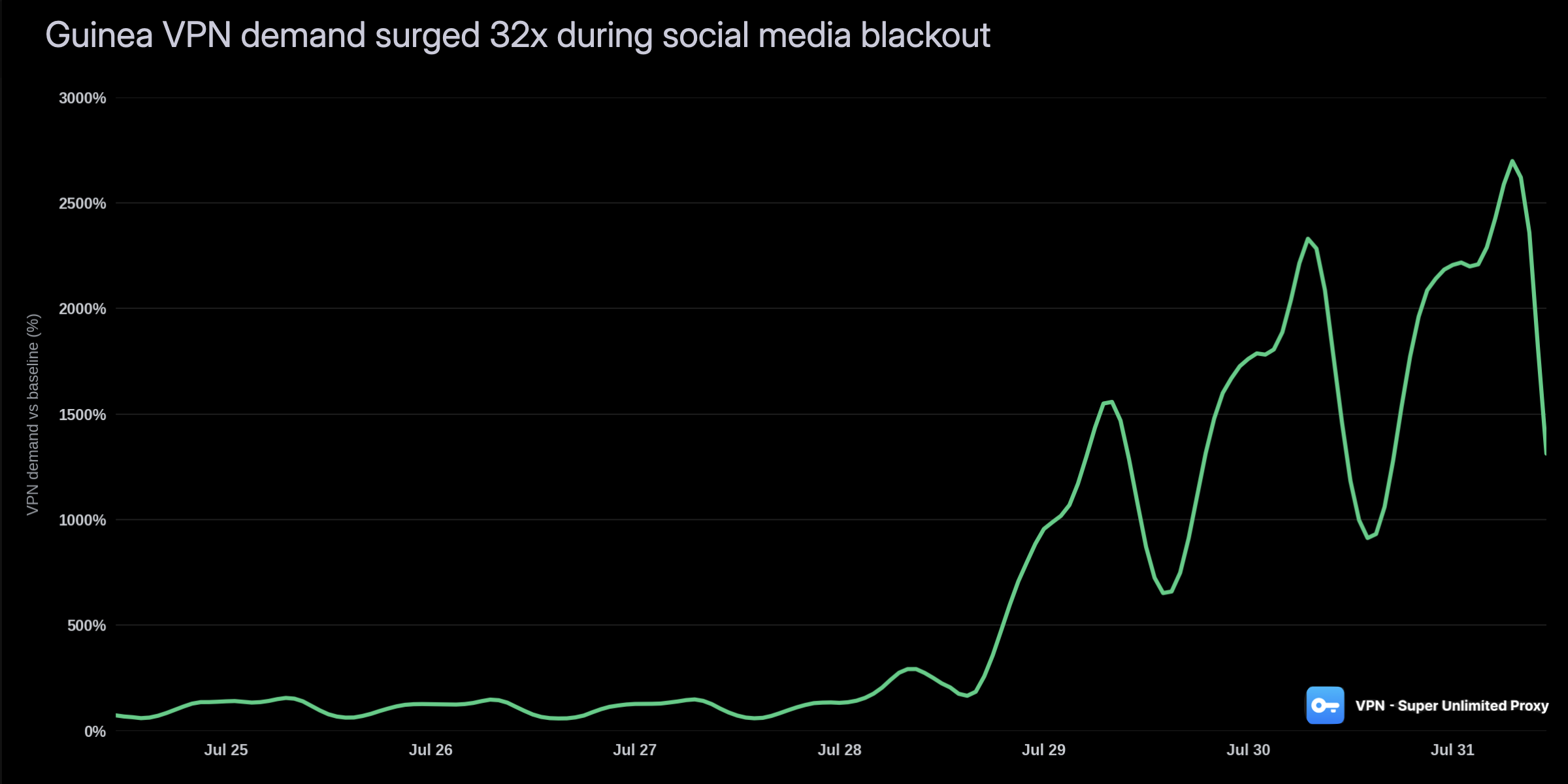
The climb didn't level off after the first shock. Traffic kept setting new highs into a fourth day, a sign that Guineans are still discovering the block rather than adjusting to it.
Day-by-day breakdown:
Three observations from the July 24–31 window, each grounded in the hourly series rather than the daily totals:
The cause is specific and confirmed: three platforms most Guineans use for news and everyday communication went dark, and nobody in government explained why. A VPN routes the connection through a server in another country, so blocked apps work again as if nothing happened.
A real, confirmed block paired with total official silence reads differently than a technical outage. Guinea's government has used this exact tool before, and each time, the platforms have come back only after public pressure built, never with an explanation attached.
The pattern is familiar well beyond Guinea. The Gabon social media blackout saw the same three platforms suspended by a regulator during a labor strike; the Cameroon election blackout hit right as a contested vote count was underway. Guinea's government reaches for the same lever whenever a moment turns politically sensitive, and it isn't alone in that.
Precedent: countries with similar restrictions
Nothing in Guinea's past blackouts suggests a fixed timeline. April's two-platform block lifted after roughly 48 hours with no announcement; this one, more than a week old, has already outlasted it several times over.
Watch for two things: whether ARPT or the government ever confirms what happened, and whether the platforms come back all at once or one at a time. Both have precedent in Guinea's recent history.
If the pattern holds, VPN demand will likely stay elevated even after service returns. That's what happened after April's blackout, and it's what this dataset will be watching for next.
Stay connected even when the internet is under threat. Download a VPN to access uncensored news, reach family abroad, and protect your communications. For other ongoing case studies, see the VPN Observatory hub, which collates measurable digital-rights events month by month.
Guinea's government blocked Facebook, YouTube, and TikTok nationwide starting July 28, 2026, hours after a cabinet reshuffle was announced overnight. Independent testing by the Guinean Bloggers' Association (ABLOGUI) confirmed the block targeted those three platforms specifically, not a general internet outage. As of this writing, the telecom regulator and internet providers still haven't explained the restriction.
No government agency has given an official reason. The block began hours after President Mamadi Doumbouya's office read out a decree reshuffling the cabinet, a night that also saw unconfirmed rumors about Doumbouya's own health spread online. Guinea used a similar blackout in April 2026, that time following a regulator warning about "harmful" online content.
VPN traffic climbed 547% on the first day of the blackout and kept rising, hitting 3,108% above baseline on July 30, roughly 32 times the pre-blackout level. The single busiest hour on record came even later, at 6 a.m. UTC on July 31, about 27 times the typical hourly volume before the block began.
Yes, as of August 06, Facebook, YouTube, and TikTok are still unreachable in Guinea without a VPN, and more than a week after the block began, nobody in government has explained why.
The pressure widened beyond digital-rights groups on August 4, when Bany Sidibé, president of Guinea's consumer defense union, publicly denounced the continued restrictions and pointed to a broader decline in internet quality nationwide. A day later, France 24 reported that access to social media in Guinea remained disrupted more than a week after the block began. Neither the telecom regulator (ARPT) nor the government has responded to either statement.
The telemetry backs that up. Every day from August 1 through August 6 produced a peak hour within about 8% of the all-time record set on July 31, and August 4 came within 2% of it. Day-over-day demand across the first five days of August moved by no more than about 3% in either direction—a flat plateau, not a spike working itself out.
Yes. In April 2026, the same three platforms plus Messenger went dark for about two days after the media regulator warned about "verbal attacks" and harmful content online. Guinea has also throttled Facebook and cut mobile data during past protests and elections, a pattern independent monitors have tracked since at least 2023.
Yes. A VPN routes a device's connection through a server in another country, so Facebook, YouTube, and TikTok load normally even while Guinea's block is active. That's what Guineans are doing right now, based on both the traffic data here and on-the-ground reporting from Conakry.
All figures in this piece cover July 24 through July 31, 2026: four days of normal traffic before the blackout, plus the first four days of the block itself.
Every number here is a percent change against the July 24 baseline day, not a raw connection count. VPN Super doesn't publish absolute usage figures for any single country.
Internal data:
News and monitoring sources:
Note: VPN - Super Unlimited Proxy does not record your VPN browsing activities in any way that can be associated with you. The telemetry referenced in this article consists of anonymized, aggregated connection counts to destination-country servers, no browsing activity, no DNS queries, no per-user attribution. Aggregate hourly totals are used to identify country-level demand patterns tied to documented digital-rights events. No personal data is shared with third parties.


 VPN for Windows
 VPN for Android
 VPN for iOS
 VPN for MacOS
 Apple TV
 Android TV