VPN Usage Surges 170% as Australia Enforces Teen Social Media Ban
Australia's world-first social media ban for under-16s took effect Dec 10, 2025, triggering an immediate 170% spike in VPN traffic. See the data on how teens are bypassing restrictions, which platforms are blocked, and the implications for digital privacy.
Privacy
VPN Super
December 9, 2025
Share:
Table of Contents
What's happening in Australia?
Australia enforced the world's first nationwide social media ban for young people under 16 in December 10, 2025. The Online Safety Amendment (Social Media Minimum Age) Act 2024 requires major platforms including TikTok, Instagram, Facebook, X, YouTube, Snapchat, and Reddit to prevent minors from creating or maintaining accounts, with companies facing fines up to $49.5 million AUD for systematic failures.
While authorities frame this as protecting children's wellbeing, privacy experts warn about data security risks from mandatory age verification, and digital rights advocates note that VPNs offer straightforward workarounds. Similar restrictions could spread globally as other nations watch Australia's implementation.
Enforcement date:
December 10, 2025
Platforms affected:
TikTok, Instagram, Facebook, Threads, X (formerly Twitter), YouTube, Snapchat, Reddit, Twitch, and Kick
Exemptions:
WhatsApp, Messenger, LinkedIn, YouTube Kids, educational platforms like Roblox (for certain features)
Age verification method:
Multiple options including government ID, facial age estimation, bank verification (ConnectID), behavioral analysis
Enforcement responsibility:
Social media platforms (not users or parents)
Penalties:
Up to $49.5 million AUD for systematic failures to prevent underage accounts
How the ban was measured
To understand how young Australians responded to the December 10 social media ban, VPN usage data was tracked.
App telemetry
Connection data from the VPN app in Australia was monitored during the ban implementation period. This data showed how quickly users turned to workaround tools once age verification requirements blocked their access. All data was anonymous and grouped by country only, no personal details or browsing history were collected.
Data was grouped, not tied to individual users
Only country-level connection counts were used
No personal information or browsing activity was collected
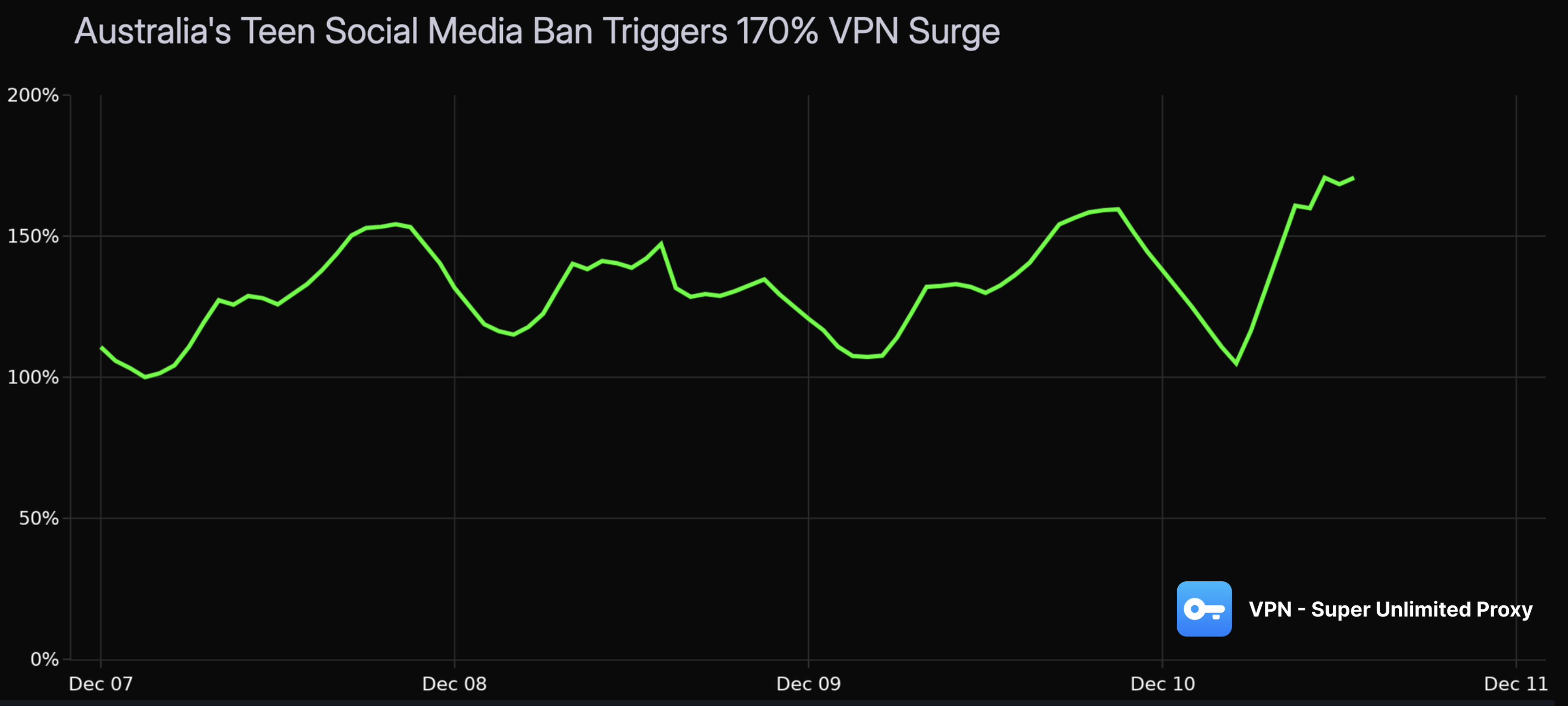
Australia VPN connections surge 170% as under-16 social media ban takes effect
As the Australian government's world-first ban on social media for children under 16 came into force on December 10, young Australians turned to VPNs in significant numbers. Daily VPN connections to key international servers in Singapore and the United States surged by 170% above baseline levels.
The data reveals a consistent "after-school spike" pattern, with traffic rising sharply between 3:00 PM and 9:00 PM each day as students sought ways to bypass the new age-verification blocks and maintain access to restricted platforms.
Key observations from the data
December 7-9 (Pre-enforcement)
VPN usage hovered between 100-150% of baseline, with minor fluctuations as users anticipated the ban. A small spike to approximately 155% on December 7 suggests some users began preparing early.
December 10 (Enforcement day)
As age verification requirements went live, connections initially dipped to around 100% in the morning before climbing sharply. By late afternoon, usage spiked to 170% of baseline, the highest point in the monitoring period, as under-16s discovered they could no longer access their accounts.
December 11 (Post-enforcement)
The elevated usage pattern stabilized at 160-170% above baseline, indicating sustained adoption of VPN workarounds rather than a temporary spike.
⚠Users should be aware:Unlike total internet blackouts in other countries, Australia's social media ban specifically targets age verification. VPNs remain fully effective for bypassing these restrictions by routing traffic through international servers where Australian age laws don't apply.
How platforms are responding
Major social media companies have begun implementing compliance measures ahead of the social media ban, though reactions vary significantly.
Meta (Facebook, Instagram, Threads)
Meta announced it will begin deactivating accounts for Australian users under 16 starting December 4, 2025. The company is:
Alerting affected users to download their content and contacts before deletion
Using "age assurance methods" to identify underage accounts
Offering reinstatement once users turn 16
Allowing wrongly removed users to verify age using government ID or video selfie
Snapchat
Snapchat is providing three verification methods for Australian users:
ConnectID (bank-verified): Links to Australian bank accounts for age confirmation
Photo ID: Government-issued ID scanned and verified by third-party service k-ID
Facial Age Estimation: Selfie-based age range estimation through k-ID technology
Snapchat accounts will be locked for up to three years, after which they will be permanently deactivated. Users who turn 16 during this period can verify their age to reinstate their accounts.
YouTube
After initially seeking exemption, YouTube confirmed it will comply with the ban. Under-16s can still:
Watch videos without signing in
Access YouTube Kids
Restricted features include:
Creating accounts
Posting comments
Uploading videos
Using interactive features
Privacy concerns with age verification
The age verification requirements have sparked significant privacy and security concerns from cybersecurity experts, digital rights advocates, and privacy commissioners.
Data breach risks
Cybersecurity expert Paul Haskell-Dowland expressed immediate concerns about methods requiring selfies or government IDs, noting "numerous cases come to light due to data breaches, losses, or misplacements". Australian consumers have raised concerns about privacy implications given the number of large-scale data breaches affecting major corporations.
Technologies are more prone to errors for young women compared to young men
Higher error rates for individuals with darker skin tones
13-14 year olds might be assessed as 16 and gain access
Some 16-17 year olds could be incorrectly classified as underage
Data collection concerns
The trial report revealed "alarming evidence" that some age assurance providers were developing tools for data tracking, raising potential for data breaches. Privacy concerns include:
Companies may use selfie data to train their systems
No universal solution means Australians may face multiple age verification requests across platforms
Unclear whether a single verification will suffice or if users need age checks at every login
Questions about how long companies retain biometric and identification data
Extraterritorial privacy enforcement
The Office of the Australian Information Commissioner (OAIC) stated that Privacy Act applies extraterritorially to "organizations regardless of their ownership or headquarters, as long as there is an Australian connection or business operations in Australia". However, enforcement typically occurs only after data breaches, by which time it may be too late.
Legal considerations
Importantly, the ban places enforcement responsibility solely on platforms, not users:
Children and parents face no penalties for bypassing the ban
Social media companies must take "reasonable steps" to prevent underage sign-ups
Using a VPN to regain legitimate access is typically allowed
However, bypassing geographic content rights or platform policies could have consequences
Effectiveness concerns
Digital rights advocates and tech experts warn the ban may prove ineffective due to:
Easy availability of VPN services
Difficulty distinguishing between legitimate adult users and minors using VPNs
Potential for pushing minors toward less regulated corners of the internet
Risk of depriving young people of vital social connections and educational resources
Impact on young Australians
Approximately 96% of children aged 10-15 in Australia have engaged with social media, with nearly 350,000 kids aged 13-15 using Instagram according to a July 2025 eSafety Commissioner report.
The ban will affect young Australians by:
Cutting off digital social connections with friends and family
Limiting access to educational content and community support
Restricting creative outlets for content creation and self-expression
Potentially driving usage underground to less regulated platforms
Creating digital literacy gaps compared to international peers
Prime Minister Anthony Albanese defended the ban as responding to parental demands rather than imposing top-down directives, stating: "That's the history of social change for common good. This will empower parents to communicate with their kids".
Global implications
Australia's pioneering legislation has attracted international attention as other jurisdictions consider similar measures:
European Union: Contemplating age limitations for social media usage
United Kingdom: Enforcing mandatory age verification for sites hosting adult content
Other nations: Watching Australia's implementation closely
This follows Australia's previous confrontations with Silicon Valley firms, including compelling tech companies to compensate for news content shared on social media and considering measures to penalize platforms for disseminating false information.
Cybersecurity expert assessments regarding data privacy risks and potential vulnerabilities in age verification systems
Privacy commissioner statements concerning the collection and retention of sensitive user data
International media coverage (BBC, Reuters, NBC) providing global context and independent reporting on the legislation's impact
Note: This article analyzes publicly available policy documents and technical reports to assess the implications of the social media ban.
Privacy
Share:
VPN Super
VPN Super is dedicated to your online security and privacy. Posts from this account will focus on company news or significant privacy and security stories.



 VPN for Windows
 VPN for Android
 VPN for iOS
 VPN for MacOS
 Apple TV
 Android TV