Afghanistan experienced a total 48-hour internet blackout starting September 29, 2025, followed by ongoing social media restrictions beginning October 7, 2025. The Taliban government cut fiber-optic and mobile internet services nationwide without warning, citing efforts to "prevent immoral activities." While full connectivity was briefly restored on October 1, authorities imposed restrictions on Facebook, Instagram, Snapchat, and other platforms, leaving millions disconnected from the outside world.
Digital Rights
VPN Super
November 20, 2025
Share:
Table of Contents
What's happening in Afghanistan?
Afghanistan experienced a total 48-hour internet blackout starting September 29, 2025, followed by ongoing social media restrictions beginning October 7, 2025. The Taliban government cut fiber-optic and mobile internet services nationwide without warning, citing efforts to "prevent immoral activities." While full connectivity was briefly restored on October 1, authorities imposed restrictions on Facebook, Instagram, Snapchat, and other platforms, leaving millions disconnected from the outside world.
Initial shutdown date:
September 29–October 1, 2025 (48-hour total blackout)
Social media restrictions began:
October 7, 2025 (ongoing)
Platforms affected:
Facebook, Instagram, Snapchat, X (formerly Twitter); TikTok banned since 2022
Censorship method:
Complete fiber-optic and mobile network shutdown, followed by platform-specific content filtering and throttling
Kabul, Balkh, Badakhshan, Kunduz, Takhar, Nangarhar, Kandahar, Helmand, and other provinces nationwide
How the restrictions were measured
To understand how people in Afghanistan responded to the September 29 blackout and October social media restrictions, VPN usage data and network monitoring were tracked from multiple sources.
App telemetry
Connection data from the VPN app in Afghanistan was monitored between September 28 and October 12, 2025. The data reveals two distinct phases of response to government restrictions.
All data was anonymous and grouped by country only, no personal details or browsing history were collected.
Data was grouped, not tied to individual users
Only country-level connection counts were used
No personal information or browsing activity was collected
Third-party monitoring tools
Network monitoring data from NetBlocks confirmed the total internet blackout from September 29–October 1, with connectivity dropping to 1% of normal levels. After brief restoration, NetBlocks confirmed on October 8 that social media platforms were "intentionally restricted" on multiple providers.
NetBlocks detected complete internet blackout affecting 43 million people
Internet watchdog organizations confirmed social media restrictions across multiple provinces
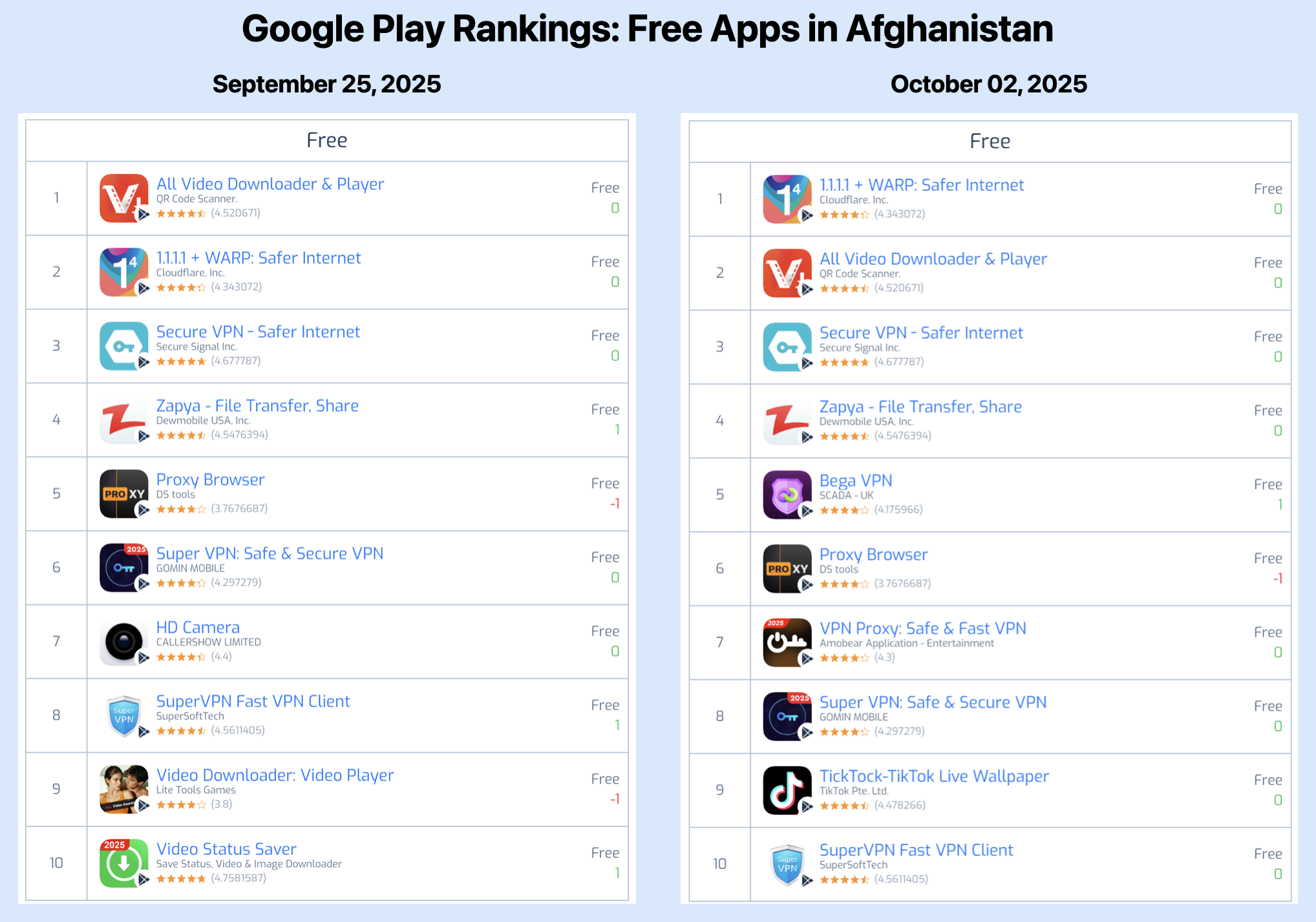
App store ranking trends from providers like AppFollow and Sensor Tower were also analyzed. These services track which apps rise or fall in the iOS App Store and Google Play.
When VPNs suddenly enter the Top Free Apps charts, it signals increased demand
By combining these approaches, it became possible to measure how quickly Afghan users adapted to the restrictions and which tools they used to maintain connectivity during this unprecedented digital isolation.
Impact on daily life: What people in Afghanistan reported
What was analyzed
Public conversations on Twitter/X, Reddit, and Facebook between September 29 and October 20, 2025, were reviewed. Posts mentioned access issues, workarounds, and impacts of Afghanistan's internet blackout and social media restrictions. Personal details were removed, keeping only country-level insights from 50 posts across all three platforms.
How posts were grouped
Each post was sorted into themes:
News and information access
Workarounds (VPNs, proxies, alternative access)
Messaging and family communication
Business and freelance disruption
General sentiment (frustration, anger)
Safety and protest coordination concerns
Theme
Share of posts
Anonymized quote
News/updates access
35%
"I could open Facebook but could not see pictures or play videos." — Reddit
Workarounds (VPNs/proxies)
24%
"This tracks with everyone I am in touch with in Kabul. WhatsApp is still accessible. VPNs are essential." — Reddit
Messaging to family
24%
"The entire telecommunications system is down. I am in Canada as well and have tried numerous apps to call my family and it doesn't work. You aren't alone." — Reddit
Business/work disruption
12%
"The Afghan business owner said he couldn't do deliveries without mobile service. Imagine how crippling this is to businesses across the entire country." — Reddit
General frustration
6%
"Cutting off and restricting internet access means silencing the voices of millions of Afghans—especially women and girls, whose only window to the world is through the internet." — Twitter
Safety/coordination
0%
No posts identified in this category
Safeguard your digital privacy and keep your internet connection secure.
"Has anyone been able to get hold of their family members in Afghanistan through any means? If yes, how did you reach them? We have tried everything including direct phone numbers in multiple cities but nothing works." - Reddit
"I was able to reach out to my cousin. He has access to Starlink internet, but apparently, the Taliban are trying to seize Starlink and other types of internet providers." - Reddit
"My wife lost all contact with her family in Kabul too. Currently I don't know how she can check on them. How do you decide to cut off all internet when so many things depend on it in the country?"- Reddit
"All the students and women we are in contact with have connected to VPNs so they can continue their online education and activities. This comes as the Taliban have blocked several applications, including Google Meet and even the Play Store." - Twitter
"TikTok was also banned but you just need to install a VPN and it works perfectly." - Twitter
PRIVACY NOTE: Only publicly available posts were analyzed. Private messages, account details, or exact locations were not collected. Quotes are anonymized and reworded when needed.
Afghanistan VPN connections more than double after Taliban restricts social media
Following the 48-hour total internet blackout and subsequent social media restrictions starting October 7, Afghans turned to VPNs in unprecedented numbers. Daily VPN connections surged by more than 100% above typical baseline levels, with some peaks reaching 350% of normal usage, as users sought ways to access Facebook, Instagram, and other blocked platforms.
The graph reveals two distinct phases of response:
Phase 1: Total blackout (September 29–October 1)
During the complete internet shutdown, connection activity dropped dramatically to near-zero levels on September 30, creating a visible trough in the data. This confirmed that even VPN services became inaccessible when fiber-optic and mobile networks were completely severed.
Phase 2: Social media restrictions (October 7 onward)
After connectivity was restored on October 1, usage gradually returned to baseline levels. However, when social media platform restrictions began on October 7, connections skyrocketed to more than double the typical daily usage, with sustained peaks reaching 125% to 350% above normal, as Afghans mobilized to bypass Facebook, Instagram, and Snapchat blocks.
⚠Users should be aware: During the total blackout (September 29–October 1), even VPNs couldn't help bypass restrictions because internet infrastructure was completely shut down. VPNs only became effective after connectivity was partially restored on October 1.
However, many Afghans have turned to free VPNs that may expose personal data, location, or browsing activity, which is particularly dangerous for journalists, women's rights defenders, and activists.
The reality check
When governments cut internet access during political control, you're suddenly:
Cut off from news about what's happening in your country
Unable to communicate with family and friends
Blocked from running your business or earning income online
Left in the dark while critical events unfold
Stuck with whatever limited access the government allows
Isolated from emergency services and healthcare coordination
For Afghan women and girls already banned from education and most public spaces, internet access is often the only remaining connection to the outside world.
Your way around it: Super Unlimited Proxy
While authorities restricted connectivity, prepared users stayed connected to the information and people that matter. Here's how to maintain access during social media restrictions:
Pakistan - Neighboring country with stable connection
India - Large server capacity, cultural ties
For global content:
US East Coast - Major platform servers, fast speeds
UK - Strong privacy protections, reliable access
Germany - European data centers, high bandwidth
💡Pro tip: Our 10Gbps servers (marked with ⚡) give you blazing speeds—no more buffering while your government buffers their decisions.
Why this matters
Other VPN companies avoid talking about real censorship. This one doesn't. When your digital rights get restricted, the VPN is here.
What you get:
One tap to restore access
Strong encryption
No activity logs (ever)
80+ global locations
Unlimited bandwidth
What you don't get:
Complicated setup
Data limits
Speed throttling
False promises
Why this page was built
Most VPN companies ignore what internet restrictions actually mean for people. This one doesn't. The belief:
Internet freedom is a right, not a privilege
Everyone deserves connectivity, especially during humanitarian crises
Real data and transparency beat marketing fluff
Methodology and sources
To analyze the Afghanistan internet restrictions, a mix of firsthand data and independent third-party sources was used:
VPN app connection data (September 28–October 12, 2025), anonymous, country-level usage patterns showing the dramatic drop during the total blackout (September 29–October 1) and subsequent surge after social media restrictions began (October 7 onward)
NetBlocks network monitoring data confirming total internet blackout affecting 43 million people, with connectivity dropping to approximately 1% of normal levels on September 29, followed by partial restoration on October 1 and confirmation of intentional social media platform restrictions starting October 7
Public social media analysis. 50 posts from Reddit, Twitter/X, and Facebook (September 29–October 20, 2025) documenting user experiences, workarounds, and impacts of the restrictions
International news outlets (BBC, CNN, Reuters, Al Jazeera, NPR, Human Rights Watch, Amnesty International, UN Mission in Afghanistan) for timeline confirmation, government statements, and firsthand testimonies from affected Afghans
U.S. Embassy security alerts and official UN statements documenting the September 29 shutdown order and subsequent telecommunications disruptions
Privacy note: All app data was grouped at country level. No personally identifiable information (PII) was collected or analyzed.
Got Blocked? Help Track It
If you're in Afghanistan (or another country facing disruptions), you can help:
VPN Super is dedicated to your online security and privacy. Posts from this account will focus on company news or significant privacy and security stories.


.png)




 VPN for Windows
 VPN for Android
 VPN for iOS
 VPN for MacOS
 Apple TV
 Android TV